
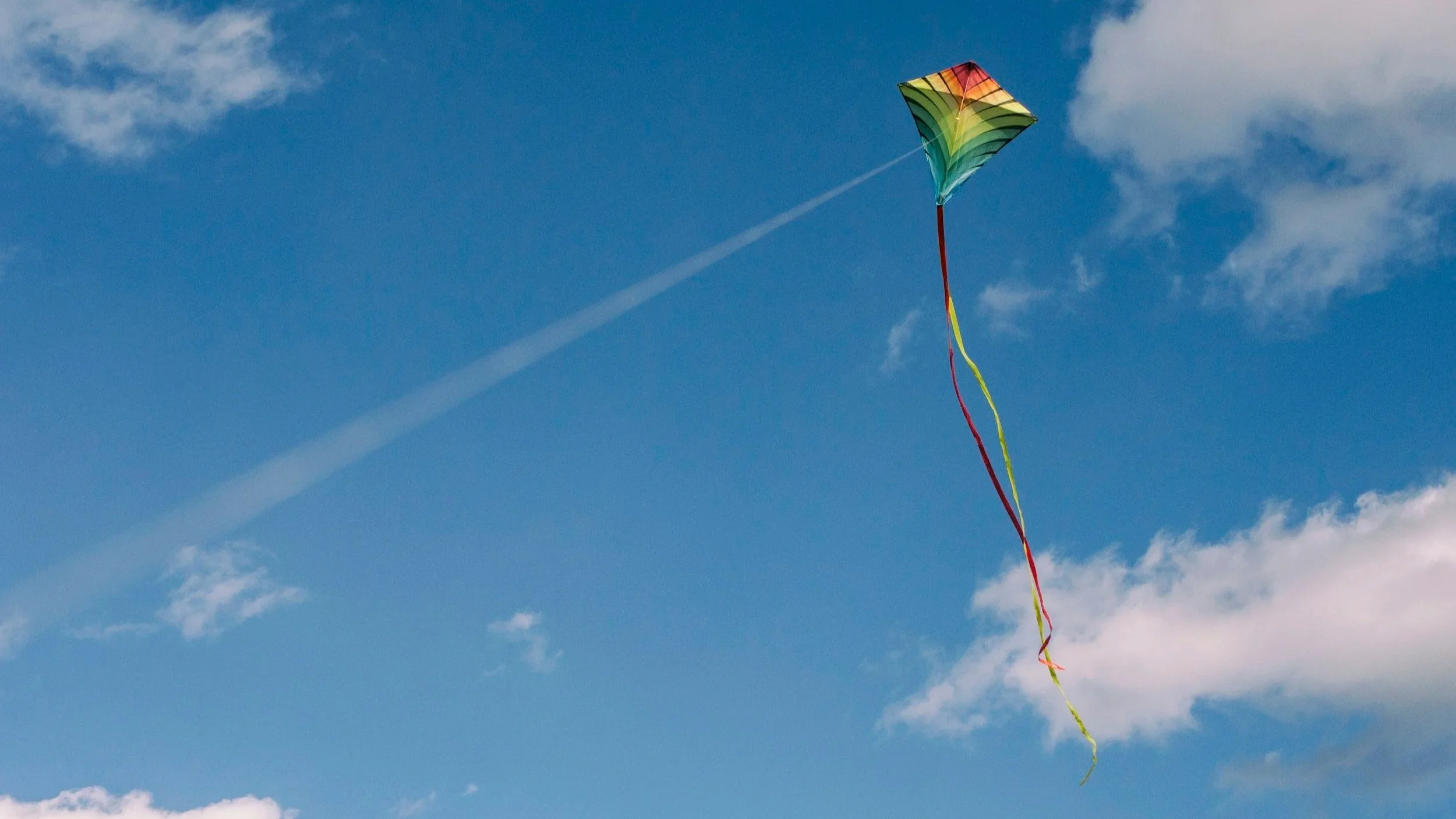
Image by @aaronburden from Unsplash
The first time I tried to run, I fell backwards.
I had not expected that. I knew the wind would be present — we were on a slope, harnesses buckled, a paragliding canopy laid out behind us like a sleeping wing. What I had not accounted for was the sheer, physical weight of the air coming toward me. It was not a breeze. It was an invisible wall, and it knocked me clean off my feet before I had taken three steps.
My tandem instructor did not offer sympathy. "Get up," he said. "Quickly."
So I did. And I ran again. Into the same wind that had just put me on the ground.
Before any of this, I had told my sister about the plan. She was immediately worried, cycling through every possible catastrophe with impressive efficiency. What if something goes wrong? What if the equipment fails? And — her personal favourite — what if you actually live out the plot of Crash Landing on You? I pointed out, as gently as I could, that given the geographical location, that would have been a very long journey indeed. But then again, I was single at the time. Perhaps finding my oppa was not the worst contingency plan.
She stayed on the ground with her concerns. I went up anyway.
From up there, I could see everything. The kind of everything you simply cannot access when you are standing at the bottom, looking straight ahead. But I am getting ahead of myself.
Let us start with a kite.
What the Kite Knows
Have you ever watched a kite being launched? Really watched it?
Picture a wide open field. A steady breeze is coming toward you. You are holding the kite in one hand and the string in the other. Here is what almost everyone gets wrong: you do not throw the kite with the wind. You do not run in the direction the air is already moving. You turn to face the wind. You hold the kite up, angled just so — not flat, not perpendicular, but tilted at precisely the right degree — and you let go.
For a fraction of a second, the kite simply hangs. Uncertain. Uncommitted. And then the wind catches the underside of it. Higher pressure builds below, lower pressure forms above, and the kite begins to climb. You feel it through the string — a tug, a pull, suddenly there is life in the line.
A kite in flight is held in balance by four forces: lift, gravity, drag, and the tension of the string. Remove any one of them, and the kite either falls or is lost. It needs all four. It needs, in particular, the resistance.
Here is the thing most people never stop to consider: you are not pulling the kite up. The wind is lifting it. Your only job is to hold the tension, maintain the angle, and let the resistance do what resistance — when met correctly — has always been capable of doing.
Four Forces, One Life
If the kite is a metaphor for a life well-navigated, its four forces are worth sitting with.
Liftis purpose. The upward pull of a calling, an opportunity, or a quiet conviction that you are meant for something more than where you currently stand.
Gravity is the weight we carry — fear, self-doubt, responsibility, the expectations of others. It is not the enemy. Without it, the kite spins out of control. Gravity keeps us honest.
Drag is resistance — adversity, opposition, difficult seasons, the voices that say not yet or not you. This is the force we most want to remove from our lives. And yet, without it, there is no lift. Drag is not your obstacle. It is your mechanism.
The tension of the string is your anchor — your values, your faith, your community, the people who hold the line even when you are too high up to see them clearly. The string looks like a constraint. It is, in fact, what gives you direction. Cut it, and the kite is free for approximately thirty seconds before it is lost.
The angle matters too. A kite must meet the wind at precisely the right degree — not head-on, not parallel, but tilted with intention. Too steep and it stalls and falls. Too shallow and it skims without rising. It is not enough simply to face the wind. Your posture in adversity determines whether resistance lifts you or simply batters you.
The Drop Before the Soar
Back on that slope, the second run worked.
Somewhere between three steps and five, the ground simply stopped being there. And for the briefest, most exposed moment, nothing held me. Not the earth, not my own effort, not the sheer willpower I had been quietly summoning since my sister raised the very reasonable spectre of Crash Landing on You. There was just open air, and the quiet terror of not yet knowing whether the resistance I had been running into would catch me or not.
Then the wing caught the air. Or rather — the air caught the wing. That fractional drop, that moment of pure exposure, gave way to lift. I felt it move through me before I understood it. And then I was soaring.
I stopped trying to do anything at all. I trusted the tandem partner behind me who knew what this wind was for. And I looked out.
I saw everything. The ground spread out below in a way that made the whole landscape strangely legible — the paths, the distances, the things that had seemed so significant at eye level now quietly arranged into perspective. From up there, you do not just see what is in front of you. You see where you are.
That perspective is only available from altitude. And altitude only comes from rising. And rising, as it turns out, requires the very thing you were most tempted to run away from.
What Happens When You Go With the Wind
It is worth asking what happens to a kite when it turns and faces the same direction as the wind — when the air is no longer coming toward it but pushing from behind.
It loses lift almost immediately. The pressure difference that was holding it up collapses. The kite wobbles, spins, loses its orientation. It may still move — sometimes dramatically, sometimes fast — but it does not rise. It is carried, not lifted. And there is a profound difference between being carried by circumstances and being elevated by them.
Eventually, without the resistance that was holding it up, it falls.
Going with the wind feels easier. It feels like relief. And perhaps, for a moment, it is. But drift is not the same as direction. Movement is not the same as growth. A kite that goes wherever the wind takes it is not flying. It is simply not yet on the ground.
Most of us know what this feels like — to follow the path of least resistance because standing apart feels too costly. To say yes when we should pause. To drift into roles, relationships, or routines not because they align with who we are, but because turning to face the wind feels like too much to ask right now. The kite moves. But it does not soar.
And How Do You Bring It Down?
This is the part most people never think about.
You bring a kite down by gradually reducing the tension. You reel the string in slowly. You walk toward the kite. You ease it down with intention. You do not cut the string. You do not yank it suddenly. Pull too hard and the kite spins and crashes. Cut the string entirely, and it is lost — carried away by the very wind that once held it up, with no way to retrieve it.
There is something quietly important here for those of us navigating seasons of great intensity. Coming down from a high-pressure season — a demanding role, a period of significant output, a stretch of life that asked everything of you — requires the same deliberate, gradual easing. You reel yourself in slowly. You stay connected to your anchor even as the altitude decreases. You do not crash-land into rest. You descend with intention.
The kite is not destroyed by landing. It is resting. Waiting for the next wind.
Today’s Monday Invitation
Most of us are waiting for the wind to die down before we launch.
We tell ourselves we will begin when things are calmer. When the circumstances are more favourable. When the resistance eases just a little. We think we are being patient. But patience and avoidance can look remarkably alike from the outside, and only we know which one we are actually practising.
The kite does not wait for calm skies. It cannot rise in calm skies. It needs the very thing it seems to be struggling against.
You fell backwards the first time. Perhaps more than once. Something — or someone — said get up, quickly. And you did. And you ran again into the same wind.
That is what rises.
This Monday, notice the resistance in your life. The push back, the friction, the wind in your face.
Ask yourself honestly: am I trying to remove it entirely, or am I learning to hold my angle?
Check your string. The anchor. The people and values that keep you from drifting away when the wind gets strong. Are you still connected to them?
The wind is not your enemy. It never was. It is what you were made to rise against.
