
Image by @alltraz from Unsplash
I did not witness my own first steps. None of us did. That particular miracle belongs entirely to someone else's memory — usually a parent's, wide-eyed and disbelieving, watching a small person wobble upright and launch themselves into the unknown.
But I was given a gift I did not take lightly: I was there for my nephew's and niece's (almost) first steps. To watch a child try, stumble, sit down hard on the floor, look briefly confused, and then try again — not because someone told them to, not because they had a plan, but because something in them simply would not stay still — that is one of the most quietly extraordinary things I have ever seen.
What we rarely stop to think about is what was happening before that moment.
Long before the first step, there were months of resistance. Every reach, every push against the floor, every frustrated attempt to hold a head upright — each tiny movement met the body's limits and built them slowly outward. The muscles that would one day carry that child across a room were being made, not in the triumphant moment of walking, but in all the smaller, unglamorous moments before it.
We were not born to run before we could walk. And something in that ordering is worth sitting with.
We live in a world that is allergic to slowness. Speed is rewarded. Instant results are expected. The gap between effort and outcome feels like failure, when sometimes it is simply the body — or the life — doing its necessary work.
Think of an athlete in marathon training. The race itself lasts a matter of hours. The preparation takes months. Long runs in the dark, early mornings, sessions where the legs feel like concrete and the mind is already negotiating its way towards the sofa. None of that looks impressive. Very little of it feels good. And yet that is precisely where the capacity is built. The race does not make the runner. The training does.
Resistance, in this sense, is not opposition. It is not a sign that something has gone wrong. It is the very mechanism through which strength is forged.
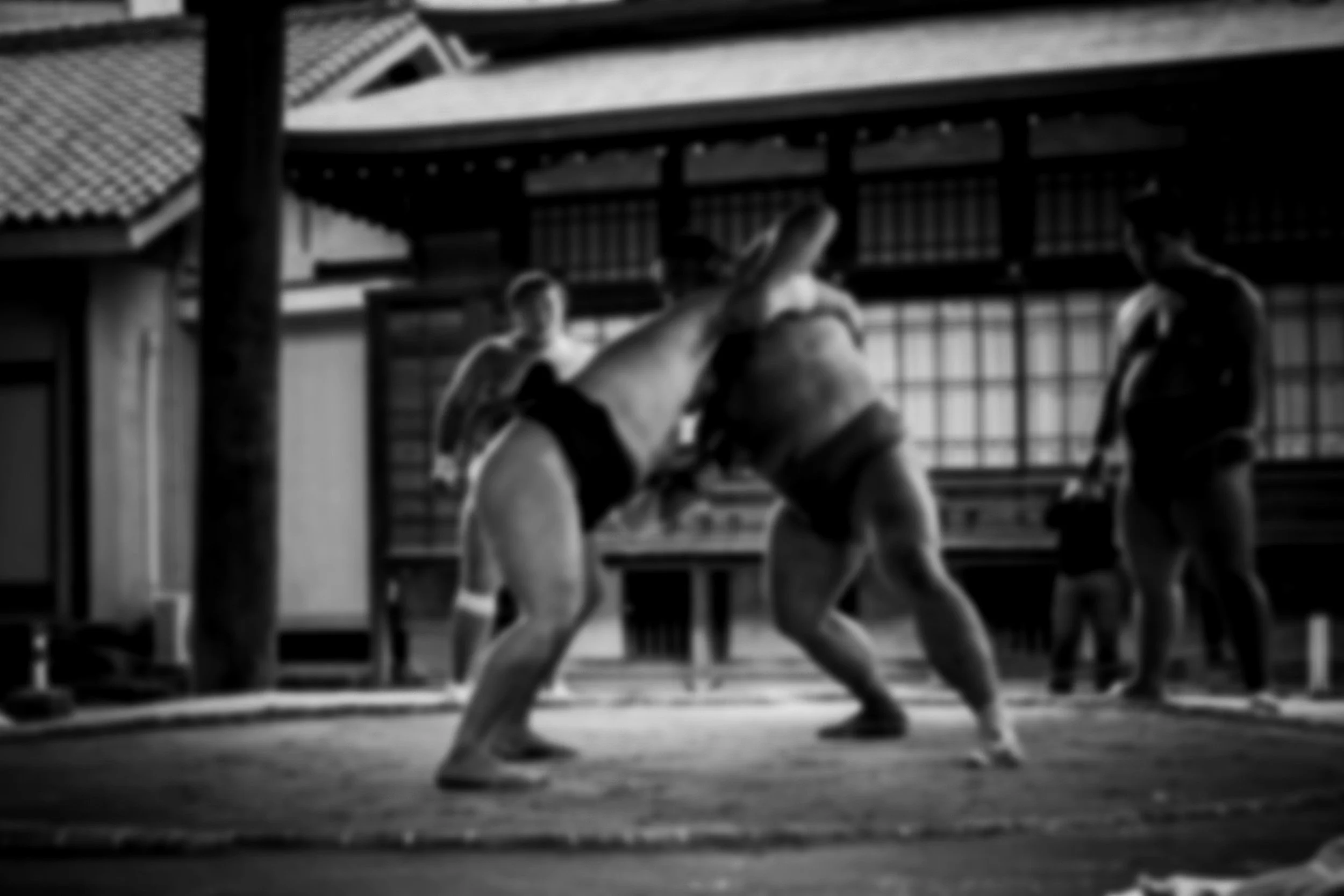
There is an image that has stayed with me: a sumo wrestler in the ring.
Two enormous athletes move towards each other, grip, and hold. For a long moment, neither gives ground. From the outside, it can look like nothing is happening. But underneath that stillness, everything is happening — each competitor reading the other, absorbing pressure, gathering information, waiting for the exact moment when the balance shifts.
That pause is not passivity. It is intelligence in action.
Some of us are in a hold right now. A season that feels heavy, fixed, like nothing is moving. A relationship that is strained, a career that has plateaued, a creative project that will not come together, a version of ourselves we are trying to grow into but cannot quite reach.
It is tempting to call that stagnation. To assume we are falling behind, or that something must be wrong.
But what if the hold is the training?
What if the resistance itself — the very difficulty of this particular season — is building something in us that ease never could?
Muscles are not made in rest alone. They are made in resistance, then rest, then resistance again. The body learns from being challenged. So does everything else worth building.
The question is not how to avoid the resistance. It is what we do while we are in it.
What resistance in your life have you been trying to escape — rather than learn from?
