
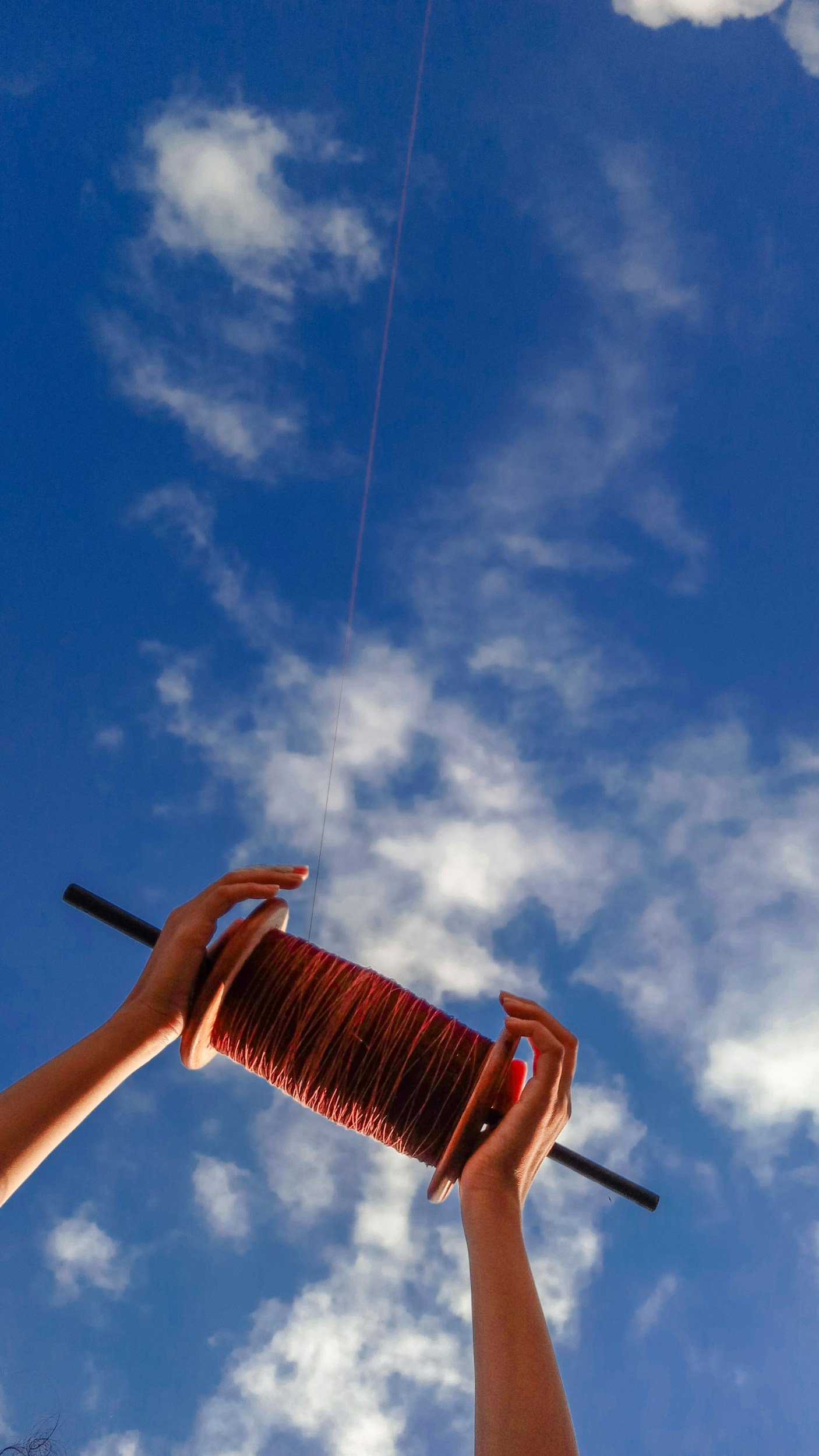
Image by @shreeyapradhananga from Unsplash
Which would hit you harder: someone else deciding to let you go, or choosing, yourself, to let something go?
I think I would struggle with both. If someone let go of something for my sake, I would carry a quiet guilt, wondering how much they gave up without telling me. And if the choice were mine, I would still hesitate. Letting go, even when it is right, rarely feels easy.
I had the privilege of watching my nephew and niece through their earliest years, and one memory I return to often is the small, warm weight of their hand in mine as we walked. For a while, that hand held tightly. Then, slowly, it loosened. One day, without ceremony, they shook free and walked ahead on their own two feet. No words were needed. The gesture said enough: I've got this now. Let me walk on my own.
It reminds me of flying a kite. And I think there are a few different reasons we keep our hand closed around the string, and only one of them is a good one.
The first is generosity. A kite is most itself when it is far above you, small against the sky, catching wind you cannot feel from the ground. To get it there, you do not grip the string tighter. You let it out, a little at a time, trusting the wind to do what your hand cannot. Every metre you release is a metre of height your own arm could never have reached. This is releasing so something can go further than you.
The second is fear, and it is the most honest one to admit. Once a kite is out far enough, it is no longer really yours to steer. The wind decides its direction now, not you. It might climb beautifully, or it might dip, twist, catch a gust you did not see coming, and there is very little you can do about it from the ground. So we keep winding the string tighter, not because the kite needs us to, but because we are not ready to hand its fate over to something we cannot control. Holding on, here, has nothing to do with the kite's height. It has everything to do with our own discomfort at not knowing what happens next.
The third is pride, and it is the hardest to admit. Sometimes we hold on not because letting go would cost the other person height, and not because we fear the wind, but because letting go would cost us something we quietly enjoy: the glory of having flown it. We keep the string wound around our hand long after the wind has stopped asking for more, because as long as we are holding it, we are still the one who flew the kite. Letting go, here, is not generosity or fear. It is the harder work of not hoarding a past or present glory, of not needing to keep our hand on something just to keep proof of who we were.
Three hands closed around the same string, for three very different reasons. Only the first one is really about the kite.
Holding on tightly does not make things advance, and it does not make us more than what we already were. Keeping something wound around our hand, whether out of love, fear, or pride, only ever brings it to a certain height and no further. More often than not, it is the releasing, not the restraining, that lets a thing (or a person, or a version of ourselves) rise into what it was capable of becoming all along.
Perhaps this is what my nephew and niece understood before I did. They were not rejecting my hand. They were simply ready for more sky, and more uncertainty, than my grip could offer them. And perhaps, in letting them go, I had to face my own fear of what they might meet out there without me, as much as I had to let go of the glory of having once been the one who held their hand.
Is there something you are holding onto so it can go further? Something you are holding onto because you are afraid of what happens once it is out of your hands? Or something you are holding onto simply because you are not ready to stop being the one who holds it?
From the Spaghetti pot: "Knowing When to Step Out" makes almost the same argument in a different kitchen — stepping back isn't defeat, it's timing.
