
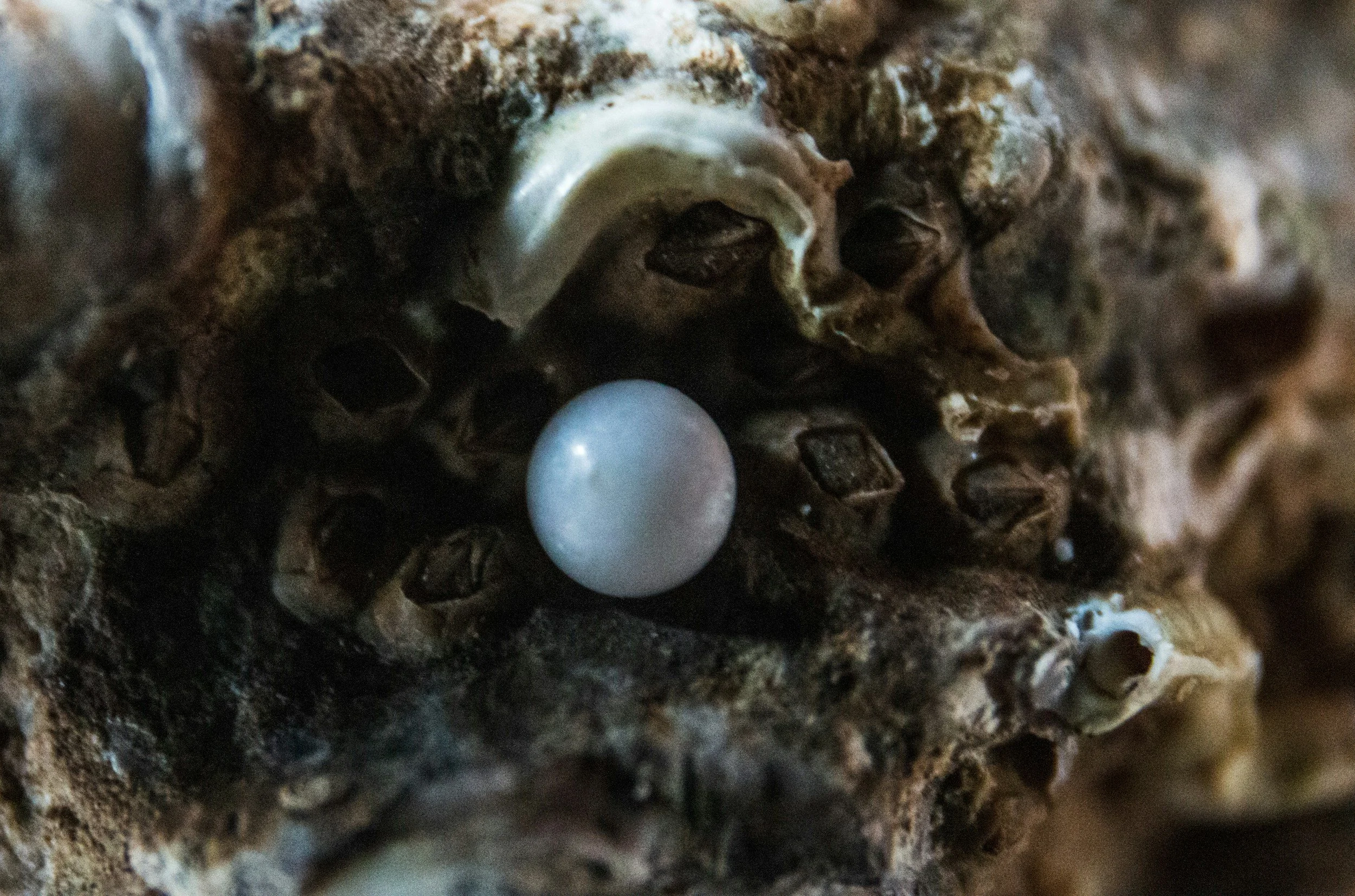
Image by @mtulard from Unsplash
Here is a story most of us have been told about pearls. That an oyster, irritated by a grain of sand, wraps it in layer after layer of nacre until something beautiful emerges from what was once a nuisance.
It is a lovely story. It is also not quite true.
The ocean floor is made of sand. Oysters live their entire lives surrounded by it. If sand were enough to trigger pearl formation, the sea would be thick with them. In reality, oysters deal with loose sand quite efficiently: they coat it in mucus and expel it. No pearl. No drama. Just a quiet, practical response.
What actually produces a pearl is far less romantic and far more instructive.
The true culprit is a parasite. A biological intruder that bores through the shell and lodges itself in the soft tissue of the mollusc, deep in the organs, where the oyster cannot simply push it out. The oyster cannot fight it directly. It cannot remove it. What it can do, however, is something quietly extraordinary.
The shell itself is worth pausing on. It is the oyster's boundary — its first and most fundamental layer of protection against an ocean full of threats. It does not go looking for trouble. The shell exists precisely so that the oyster can live, grow, and function without being constantly exposed.
And yet, sometimes, despite that boundary, something slips through unnoticed. Not because the oyster was careless. Not because the shell was weak. Simply because some parasites are persistent, and no boundary — however well-formed — is entirely impenetrable.
We know this feeling.
We build our own shells too. Healthy habits, discerning friendships, professional boundaries, the quiet but firm lines we draw around our time, our energy, our sense of self. And most of the time, they hold. But occasionally, something gets through anyway. A relationship that gradually reveals itself. A workplace culture that slowly erodes. A dynamic that was already inside before we recognised it for what it was.
When that happens, it is not a verdict on the quality of your boundaries. It is simply the reality of living in proximity to others.
There is something the oyster and the human share that goes beyond the obvious. Neither chooses the moment of intrusion. The parasite does not announce itself. It slips in quietly, often before we have had a chance to respond, and by the time we are aware of it, it is already lodged somewhere tender.
“Heat” works the same way. In my book If Humans Were Spaghetti, I wrote: "We do not choose the heat. It arrives on its own terms." The parasite is heat of a particular kind — relational, environmental, slow-burning. It does not ask permission. It does not wait until you are ready. It simply arrives, and you are left to decide what to do with its presence.
The oyster's answer, it turns out, is the same as ours must be. Not to fight what cannot be fought directly. Not to collapse under what feels immovable. But to build — deliberately, patiently, and with the quiet conviction that what you produce in response to the intrusion will outlast the intrusion itself.
The oyster does not dismantle its shell in shame when the parasite arrives. It keeps the shell. And then it does the next thing.
It builds around it.
The mantle, a remarkable secretory organ lining the inside of the shell, begins to coat the intruder. Layer by layer, it deposits nacre — that luminous, iridescent substance also known as mother-of-pearl. It does not do this in one swift motion. A mollusc secretes roughly three to four concentric layers per day, each measuring about one micron in thickness. One micron. Thinner than a human hair. It is patient, consistent work. And over time, the result is one of the most coveted and beautiful objects in the natural world.
The parasite did not become beautiful. It was covered. Contained. Transformed from a threat into something the oyster could live with, and something the world would eventually marvel at.
Sit with that for a moment.
Because most of us, at some point, will encounter a person or an environment we cannot simply expel. The colleague whose behaviour quietly erodes confidence. The family dynamic that drains rather than restores. The workplace culture that rewards the wrong things. Some of these, we can distance ourselves from. Others, we cannot. Not immediately. Not without cost.
We call them toxic. And they are. But the language of toxicity, while accurate, can leave us feeling powerless. As though the only options are to endure or to escape.
The oyster suggests a third way.
It does not pretend the parasite is not there. It does not catastrophise about it either. It simply begins to build. Quietly. Consistently. One layer at a time.
That building is worth examining more closely. The nacre the oyster produces is not a wall. It is not armour in the aggressive sense. It is more like a clarification of self — a strengthening of one's own identity around the point of intrusion. The oyster does not become less of an oyster because of the parasite. In a sense, it becomes more fully itself in response to it.
This is the question the oyster asks of us: what are you building around what you cannot remove?
Are you building resentment? Cynicism? A performance of fine-ness that costs more energy than it earns? Or are you, layer by layer, building something more durable: clarity about your own values, a steadier sense of who you are, the capacity to remain present and purposeful even in an environment that does not fully deserve you?
This is not a call to romanticise difficulty. Parasites are harmful. Some situations must be left. And knowing when to step away is its own form of wisdom.
But for the seasons when leaving is not yet possible, or not yet wise, the oyster's method is worth considering. You build slowly. You stay consistent. You do not let the intruder define the shape of everything inside you. You make something of it.
And here is what makes a pearl truly exquisite. It is not merely the lustre or the shape. It is the knowledge of what it took to produce it. A pearl found inside an oyster is rare precisely because the process is slow, hidden, and entirely uninvited. No one plants a parasite hoping for beauty. The beauty is incidental — a byproduct of the oyster refusing to be consumed.
That is the story worth telling. Not that you endured something difficult, but that you did not let it define the whole of you. That you built around it, layer by layer, until what was once a source of quiet pain became something you could carry with grace. The parasite does not get to be the ending. You do.
A pearl, after all, is not despite the parasite. It is because of what the oyster chose to do with it.
Pause here for a moment.
Where have you maintained strong boundaries, yet something still slipped through? Have you been holding yourself responsible for that in a way that is not entirely fair?
And the harder question: what are you building around what you cannot remove? Resentment, withdrawal, a performance of fine-ness — or something more durable?
Is there a situation you need to leave, rather than build around? Only you know the difference.
—-
Disclaimer:
Facts sourced from Ripley's Believe It or Not.
If this resonated, Chapter 4 of If Humans Were Spaghetti explores what we become when the heat is not something we chose — and how we navigate it with purpose.
