
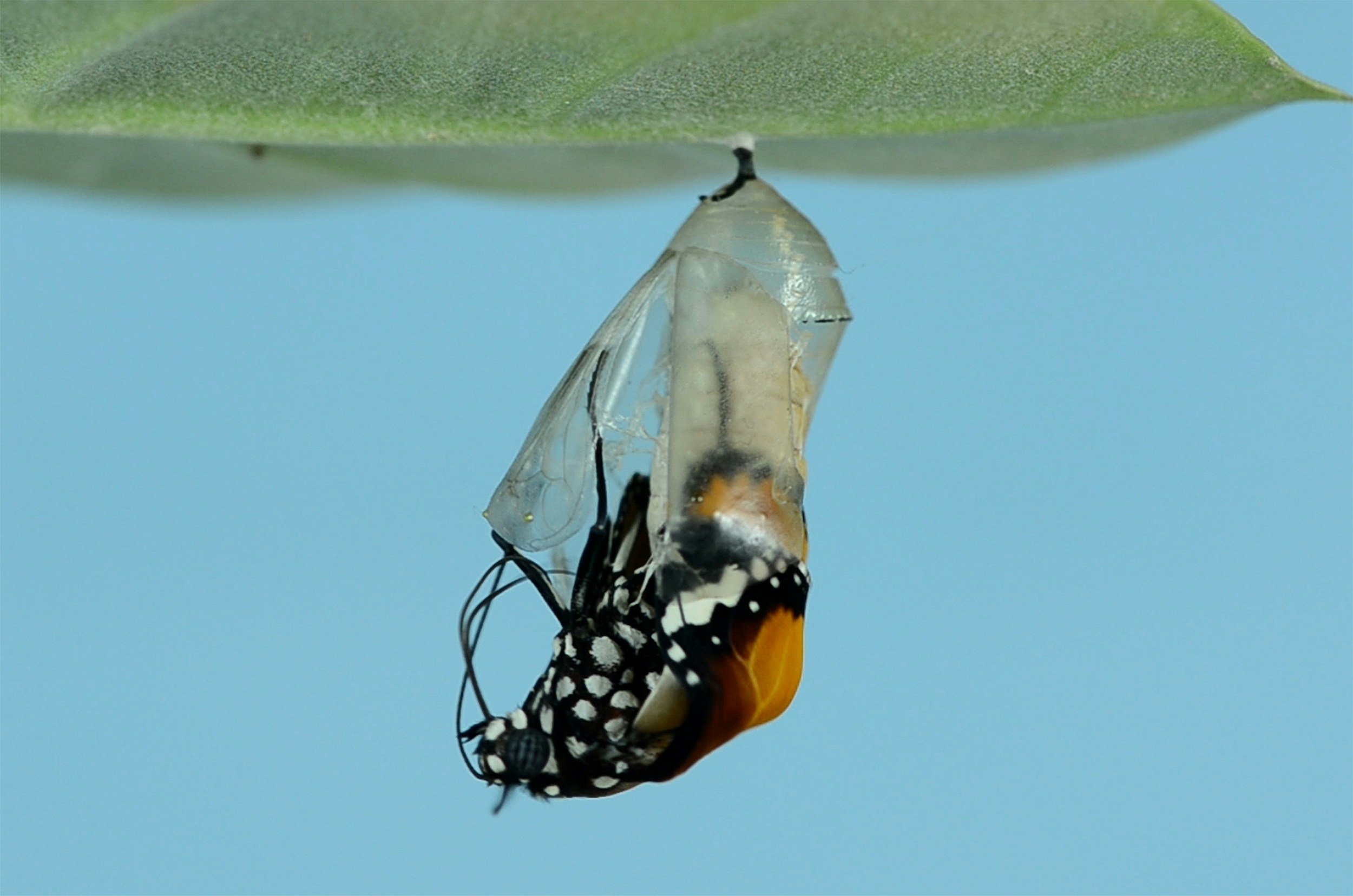
Image by @rochangraphics from Unsplash
Some transformations require you to stop being what you were first.
That is not a comfortable idea. We tend to think of growth as additive — that we simply layer new skills, new habits, new versions of ourselves on top of what already exists. But occasionally, life asks for something more disorienting than addition. It asks for dissolution.
Consider the caterpillar.
Most of us were taught the life cycle in school: egg, larva, pupa, butterfly. We know the stages. What we are less often told — what tends to get glossed over in the diagram — is what actually happens inside the chrysalis. The caterpillar does not simply rearrange itself. It breaks down almost entirely, its cells digesting themselves into a kind of biological soup, before the butterfly begins to organise from within.
It dissolves before it becomes.
And the conditions matter enormously. If the chrysalis falls and is bruised, the suspension needed for proper emergence is compromised. If it is bent or dented, the developing wings can become permanently deformed. If the outer shell cracks, bacteria enter and the process becomes fatal. If the caterpillar fails to shed its final skin completely before sealing itself in, it cannot make the transition at all.
In other words: the in-between stage is not passive waiting. It is precise, protected, and entirely necessary. One careless step undoes everything.
We see this same principle played out in stories we love, even if we rarely name it.
Think of almost any film where the central character faces a defining confrontation. Before the final act, there is almost always a retreat. A period of withdrawal, away from noise and distraction and the opinions of others. It is not a dramatic flourish — it is a structural necessity. The character cannot face what is coming as they currently are. Something must be shed, reconsidered, or released before they can step into who they are becoming.
The audience often grows impatient during these scenes. We want the action. We want the resolution. But the writers know what the biology of caterpillars confirms: the quiet, unseen preparation is not separate from the transformation. It is the transformation.
Now, what about us?
Are we moving through seasons of growth with that kind of intentionality, or are we simply moving — going through the motions, surviving the week, managing the noise? There is a difference between progressing and enduring. Both involve effort. Only one involves direction.
In If Humans Were Spaghetti, I wrote about the dried spaghetti in the box — rigid, precise, protected. The box is not a bad place. It provided structure, and structure has its purpose. But the spaghetti is not meant to remain there indefinitely. The box is a beginning, not a destination. At some point, it must meet the boiling water. And when it first enters, it is a little chaotic. The starch clouds the water. The rigid strands resist. But give it time, and something shifts. Something softens. The heat does what the box never could.
The chrysalis is not so different from the box. Both offer containment. Both are stages, not endpoints.
But here is what I want to draw your attention to: when the butterfly finally begins to emerge, it cannot be rushed. The struggle to break through the cocoon is not a design flaw. It is the mechanism. That effort pushes fluid into the wings. Without the resistance, the wings do not develop the strength needed for flight. If someone were to cut the cocoon open to "help," the butterfly would emerge too weak to survive.
The difficulty is not incidental. It is the point.
So when you are in your own chrysalis season — when things feel uncertain, when you cannot quite see what you are becoming, when the old version of you seems to be dissolving faster than the new one is forming — consider the possibility that you are not behind. You may simply be in the middle of a process that cannot be rushed, witnessed from the outside, or skipped.
The caterpillar does not multi-task. It does not try to remain a caterpillar while becoming a butterfly. It surrenders completely to the process.
That kind of surrender takes courage. It also takes trust — trust that what is forming inside the chrysalis has more potential than what was before it.
Some seasons are not about doing more. They are about becoming different. And sometimes, becoming different first requires you to stop being who you were.
The wings are forming. Give them the time they need.
