
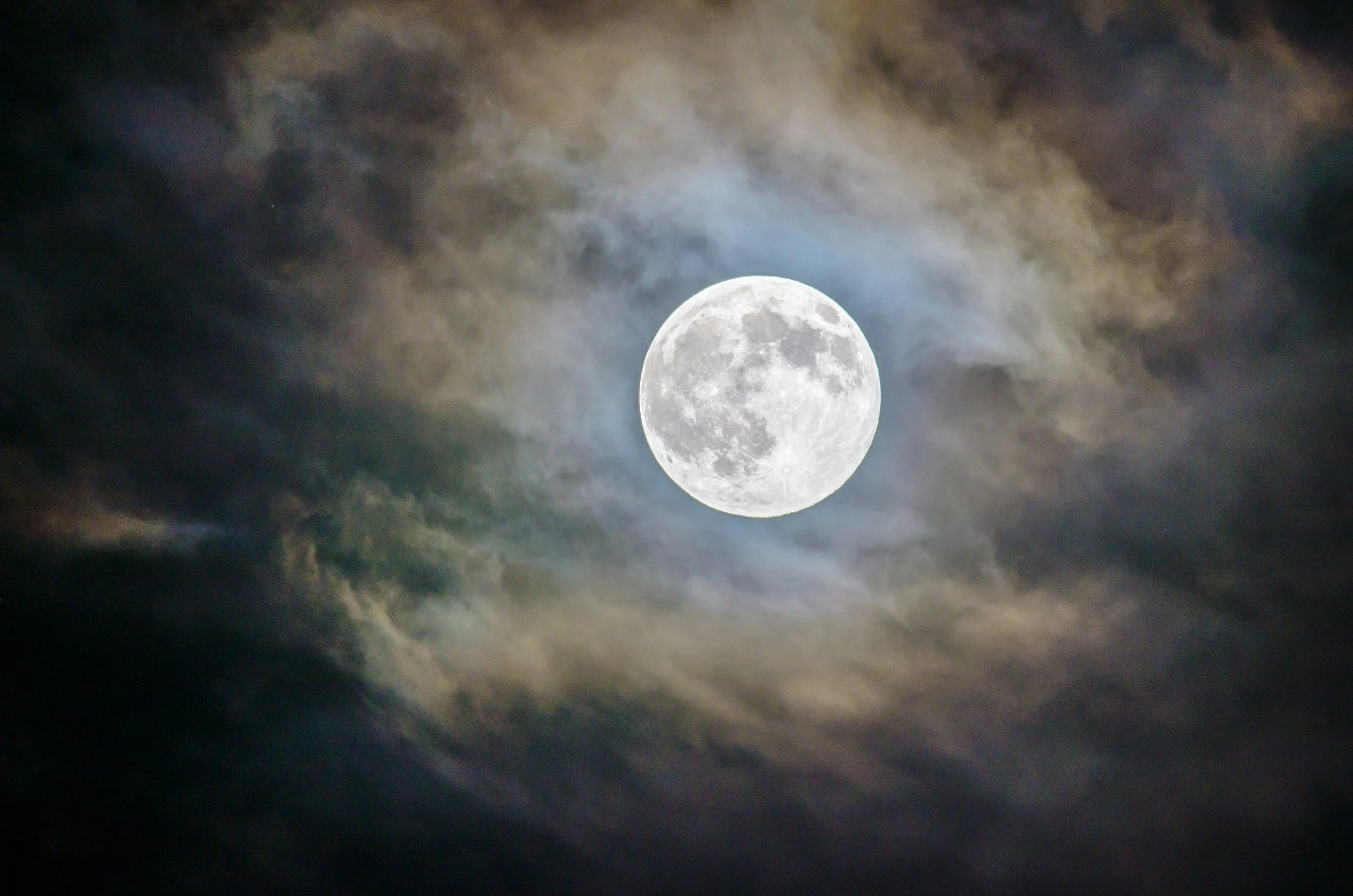
Image by @gkumar2175 from Unsplash
There's always something enchanting and mystical about the moon. I love how it illuminates the dark skies at night — its icy, still light so inviting that you almost want to draw closer. Regardless of its cycle — full moon, or just the thin silver crescent that looks like the Cheshire Cat in Alice in Wonderland — it brings a kind of hope and quiet light into the stillness of darkness.
Even in broad daylight, if you look closely enough, you can still catch a faint hint of it in the sky. It doesn't even try to hide.
Then one day it occurred to me, and I asked my husband: Are we always looking at the same side of the moon?
Short answer: yes. The moon is tidally locked to Earth, meaning its rotational period perfectly matches its orbit. Because it takes the same amount of time to rotate on its axis as it does to orbit Earth, the same hemisphere always faces us.
Which led to the next question: what does the other side look like?
A quick search turned up something interesting. If the far side of the moon faced Earth instead, the surface would appear noticeably brighter, and there might be some disruption to nocturnal wildlife that rely on darkness to hunt. So many what-ifs in that one small thought.
But here's what struck me most: the far side of the moon is not actually dark. It receives just as much sunlight as the side we see. It simply never faces us.
Perhaps that is a more honest way to think about the hidden parts of ourselves too. Not darkness, really. Just... unseen.
We each carry a side that others rarely encounter. Not because we are concealing something shameful, but because life — much like the moon's orbit — determines what gets shown and to whom. The version of you at work is not a pretence; it is simply the face that turns towards that particular world. The version of you at 2am, sitting quietly with your own thoughts, is just as real. Neither cancels the other out.
And this isn't a Dr Jekyll and Mr Hyde situation — two opposing selves at war. It is simply the nature of being human. We are whole people. We just don't show all of ourselves all at once, and we were never meant to.
The difference between us and the moon, of course, is that we have a choice. The moon is tidally locked — it has no say in what it reveals. We do. And that is where it gets interesting.
There are things we keep on the far side not out of deception, but out of self-protection. Grief we haven't fully processed. Dreams we haven't said aloud because saying them makes them real. Fears we've carried so long we've forgotten they're there. These aren't flaws. They're the texture of a life still being lived.
I think about the people I admire most — not the polished, curated versions they present, but the moments when the far side briefly turns towards me. A quiet admission of doubt. A crack in the confidence. A me too when I expected a pep talk. Those moments don't diminish them. They make them human.
Maybe the question isn't what we're hiding — but whether we've given ourselves permission to know our own far side. To sit with it. To stop treating the unseen parts of ourselves as something to be managed, and start treating them as something to be curious about.
Scientists have photographed the far side of the moon. It took decades of exploration and extraordinary effort — but they got there. And what they found was striking: it looks quite different from what we see. Rougher. More cratered. Less smooth. A harder surface, shaped by a different kind of exposure.
That feels familiar.
The parts of us shaped in private tend to carry more texture. They haven't been softened by the light of social performance. They've been through more. And perhaps, in the right company, those rougher, less-seen parts are the most meaningful things we could ever offer.
The moon doesn't try to hide its far side. It simply is what it is — whole, regardless of what Earth can see.
You are the same.
So, pause and notice:
What lives on your far side — the parts of you that rarely face outward?
Are those parts hidden by choice, or simply by circumstance?
Is there someone in your life with whom your far side feels safe enough to turn towards?
And if you turned the curiosity inward — what might you discover about yourself that you've been too busy to notice?
You don't have to show everyone everything. But it's worth knowing what's there.
