
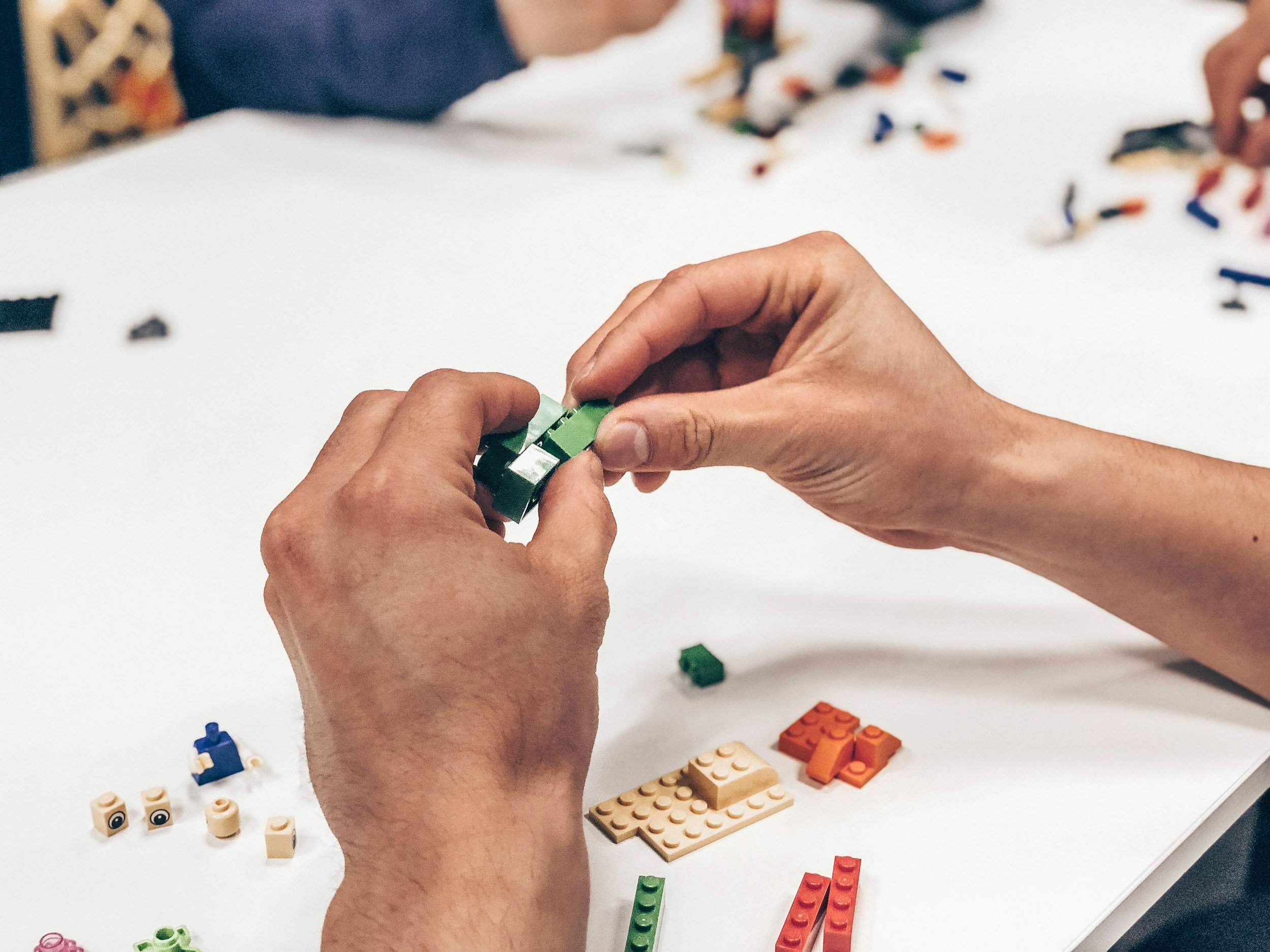
Image by @sebastien_bonneval from Unsplash
There was a season when I was completely obsessed with Lego. I’m still am.
Not the decorative kind you display on a shelf. I mean the kind where you sit on the floor for hours, instruction booklet spread open, piece by piece, convinced you are making progress. And then, somewhere in the middle of it all, you realise you missed a step. Not a small one. One that matters. One that means everything above it is now slightly, stubbornly wrong.
And you have a choice: leave it and hope no one notices, or pull it apart and start again from the point where things went sideways.
I always pulled it apart. Not because I enjoyed it. Because I knew that if I didn't, the whole thing would be misaligned. It might hold together for a while, but it would never be what it was supposed to be.
That is a surprisingly accurate picture of what falling apart in life actually looks like.
We don't talk about this honestly enough. We talk about resilience and bouncing back, as if the falling is just a brief inconvenience on the way to the comeback. But sometimes the falling is the point. Sometimes you have to come apart, not despite the process, but because of it. Because somewhere along the way, you missed a step. You built on top of something that was never properly set. You kept moving because stopping felt like failing.
And then life makes the decision for you.
Before any significant building goes up, the foundation has to be dug out and laid correctly. You don't see that part. It's not visible once everything is standing. But it is what everything else rests on. Get it wrong, and the cracks will appear eventually, quietly at first, then impossible to ignore.
The same is true for us.
There are things we build our lives on that feel solid until pressure is applied. Identities tied to roles that disappear. Confidence borrowed from other people's validation. Busyness used as a substitute for purpose. You don't always know these things are shaky until something forces you to stop and look.
That is what falling apart does. It makes you stop and look.
What I found, in the moments I was most undone, was that I had been looking outward for a long time. At what others were doing. At what I was supposed to be achieving. At how I measured up. And it was only when all of that noise quieted, when there was nothing left to perform or prove, that I finally looked inward.
Not comfortably. Not immediately. But honestly.
That is where the rebuild begins. Not with a plan. Not with a strategy. With a question, asked quietly, in the wreckage: What actually went wrong, and what do I need to do differently this time?
Pulling the Lego apart was never the failure. Building it wrong and refusing to acknowledge it would have been.
The same goes for us.
