
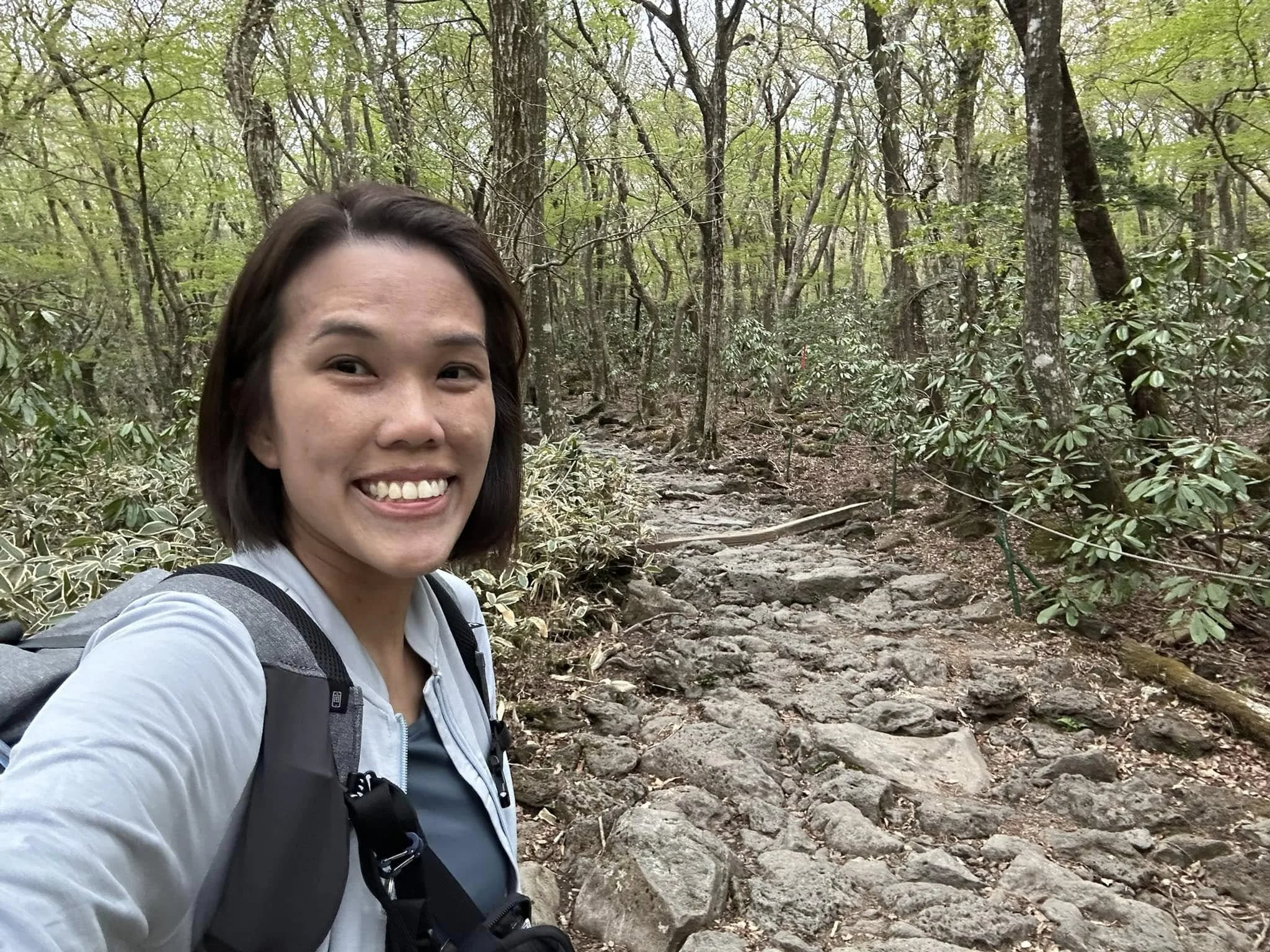
Pardon the dark circles and eye bags…there’s a reason behind it.
Let me be honest with you about something I glossed over in my book.
I described the Mount Hallasan climb beautifully. The pre-dawn queue. The passport check. The humbling moment an elderly woman offered me her hiking stick. I ended on quiet inspiration — the idea that stepping into the heat gives others permission to try. All of that is true.
But it is not the whole truth.
Here is what I did not say: there were multiple points on that mountain where I genuinely considered stopping. Not in a dramatic, cinematic way. In a tired, embarrassed, quietly desperate way. The kind where you are not making a speech to yourself about resilience. You are just... done. Your legs are burning. Your lungs are complaining. And your brain is asking one very reasonable question: who told you this was a good idea?
I did. I told myself this was a good idea. And halfway up that mountain, I deeply resented her.
What I was actually thinking
There is a particular cruelty to solo hiking that no one warns you about. When you climb with people, the complaining is shared. The misery becomes community. You laugh at each other. You drag each other forward. When you are alone, every thought is your own — and thoughts, when you are exhausted, are not kind.
At some point along the Seongpanak Trail, I stopped pretending I was fine. My legs had moved past sore and into something that felt structural. Like the scaffolding was going. I sat on a rock — not for a scenic moment, not for a photo — because I had no choice. I needed to stop.
And I thought: I could just go back now.
Not quit, I told myself. Re-evaluate. (We are very creative with our language when we want to avoid admitting something.)
The thing that stopped me from turning around was not courage. It was not some motivational line I had memorised. It was something more uncomfortable: the knowledge that giving up would not actually be easier. I still had to get down the mountain either way. The trail does not disappear because you change your mind. If I stopped here, I would still have to descend — exhausted, without the summit, and carrying the specific weight of having chosen not to finish.
So I asked myself something I did not expect to ask: what is the difference between not wanting to complete this and not being able to?
Because those are two very different things. One is a limit. The other is a choice.
I was not unable. I was unwilling. And I had to decide whether I was willing to sit with that truth.
The thing about doing something alone
When you are hiking solo, no one is watching you quit. That should feel freeing. It does not. It means the only person you are accountable to is yourself — and yourself is not particularly sympathetic when you are this tired.
There is also no one to convince you to keep going. No one to say, "Come on, we are almost there." You do not get the borrowed energy of someone else's determination. Everything you find, you have to find in yourself, and some days, that well is genuinely shallow.
I wanted a bath. I wanted my bed. I wanted that meal I had plan to go after the climb. I wanted, deeply and specifically, to not be on that mountain.
But here is what I also knew: I would have to tell this story eventually. Not to impress anyone. Just because that is how I process life — I write it, I share it, I sit with it until it makes sense.
And I did not want the story to be: I stopped because it was hard.
Not because stopping is shameful. It is not. Sometimes stopping is the wisest thing. But I knew, in my body, that I was not at my limit. I was at my discomfort. And those are not the same place.
The summit that was not there
I nearly made it. The final stretch was closed — adverse weather, no negotiation, no exceptions. I stood at the boundary and looked at what I could not reach, and I felt something strange: I was not only disappointed. I was also, underneath it, relieved.
Relieved that the mountain had made the decision for me. Relieved that I did not have to find out whether I could have done the last bit. The decision was taken out of my hands, and some small, exhausted part of me was grateful.
That feeling taught me something I am still sitting with: sometimes we are more afraid of what we might discover about ourselves if we succeed than if we fail. Failure has a kind of comfort in it. You know where you stand. Success asks something more of you. It says: now what?
I did not get to ask that question on Hallasan. I got something harder — an honest reckoning with how far I had come, without the clean ending of a summit photo.
The descent was brutal in a different way. Going up, you are chasing something. Going down, you are just trying to survive. My calves were beyond sore. My knees were lodging formal complaints. It took everything I had just to keep moving at a pace that was not embarrassing.
I made it back to the base. Eight to ten hours. Mission accomplished — whatever that now meant.
What I learned, unfiltered
Giving up is always the easier choice. I wrote that in my book and I meant it. But I want to add something I left out: giving up is also sometimes the right choice. Knowing the difference is the actual skill.
On that mountain, I was not at the end of myself. I was at the end of my comfort. And learning to distinguish between the two is something I am still practising.
I also learned that doing hard things alone is different from doing them badly. I did not need a hiking partner to make it meaningful. I needed honesty — with myself, about what I was actually capable of, and what I was simply trying to avoid.
The climb gave me a story. Not a perfect one. Not a triumphant one. A real one — bent, humbling, unfinished at the summit, and still somehow mine.
That is more than enough.
One question to sit with
The next time you consider walking away from something — ask yourself this first: Am I at my limit, or am I at my discomfort?
The answer will tell you everything.
This moment is touched on in If Humans Were Spaghetti (Chapter 4: In the Heat) — about what it means to endure pressure, and the difference between reacting and responding. If the climb resonated with you, the book goes deeper into how heat shapes us, and how we find our way through it.
