
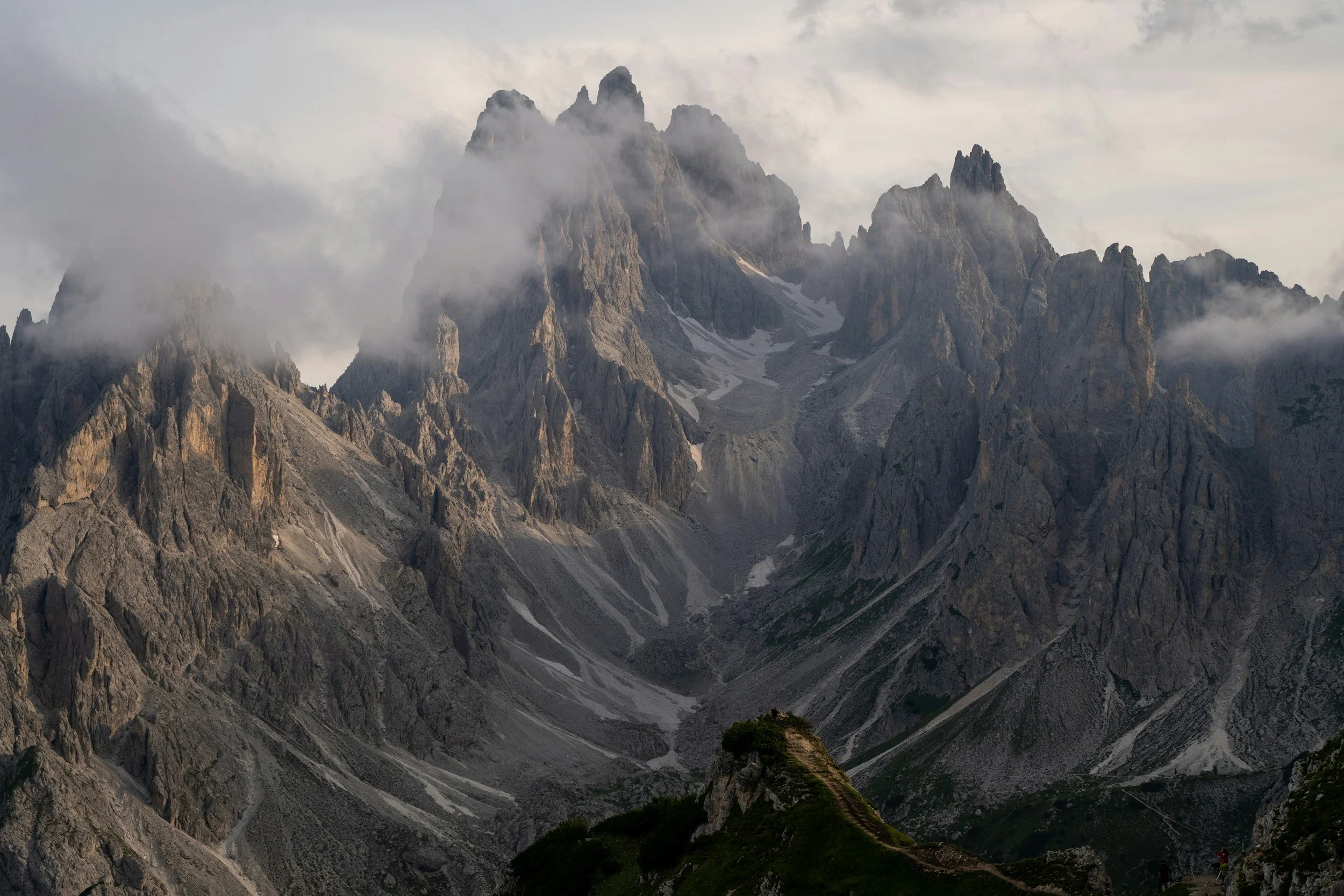
Image by @otiswo from Unsplash
There is a moment early in The Lord of the Rings when Gandalf sits across from Frodo in the quiet of Bag End and says, matter-of-factly, that the ring must leave the Shire. That Frodo must go with it. That the road will be long, and dangerous, and not entirely survivable.
Frodo's response is something most of us have felt at some point: "I am not made for this."
And yet he goes. Not because the path was clear, or the outcome certain, but because there was no other way. The obstacle — the ring, the quest, the whole impossible weight of it — was not blocking his life. It had become his life.
What strikes me most about Frodo's journey is not the heroism. It is the imperfection. He does not destroy the ring in the end. Not really. It is Gollum, the most unlikely of participants, who finishes what Frodo could not. An unfinished, imperfect effort that nonetheless changed everything.
And crucially: once Frodo was on the path, there was no going back. There was only forward.
Life works the same way. The obstacle is not the detour. Quite often, it is the path itself.
A few years ago, I took my first solo trip. I chose Jeju, South Korea, and I chose to climb Mount Hallasan, the highest peak in South Korea. Not a city stroll. Not a gentle scenic walk. A mountain.
There were two trails: Seongpanak, the gentler ascent, and Gwaneumsa, the steeper route. I chose Seongpanak first, not out of hesitation, but out of practicality. My thinking was straightforward: if something went wrong along the way and I needed to turn back, I would at least be descending a gentle slope rather than a steep one. A sensible contingency, nothing more. The plan was still to reach the top, come down the harder route, and have a story worth telling. I arrived before sunrise. Passport checked (yes, tourists need one to access the summit trail), nerves steady, optimism intact.
"I can do this," I thought.
Then reality arrived, without knocking.
There were no shortcuts, no escalators, no mercy. Just endless steps, steep rocky terrain, and slopes that seemed to laugh quietly at my optimism. Halfway through, regret set in properly. I remember thinking: why did I think this was a good idea? And I realised there was no way forward except through.
To make matters more humbling, elderly locals passed me with ease, chatting casually to one another whilst I was barely keeping myself upright. One elderly lady even offered me her hiking stick. I politely declined, which was perhaps the proudest and most foolish decision of the entire climb.
I nearly reached the summit. Nearly.
The final stretch was closed due to adverse weather. The decision was taken out of my hands entirely. I stood there, just short of the peak, equal parts disappointed and oddly grateful. And then the harsh reality arrived: to get down, I had to descend the same way I came up. That gentle slope I had planned as a contingency was now simply the only way home. I had felt as though I might die on the way up. I tried very hard not to die on the way down. Certainly not how I had imagined my first solo adventure ending.
Eight to ten hours later, I reached the base. Body intact. Pride somewhat rearranged.
After Jeju, I met my sister in Seoul, where she was attending a work conference. Over a meal, I shared the whole story with her and those with her: the climb, the struggle, the closed summit, the soreness that lingered for days afterwards. I did not think much of it at the time. It felt like the kind of story you tell simply because it happened, not because it matters.
One of the people at that time was planning to visit Jeju straight after the conference. She went. She climbed Mount Hallasan. And she reached the summit I did not.
I will be honest: I was a little envious. She showed me photos of everything I had missed, and I smiled and meant it, even while a small part of me was quietly sulking. But underneath that, something else settled in. Something quieter and more unexpected.
My imperfect, unfinished climb had given her the permission to try.
I had not reached the summit. I had not done it perfectly. I had nearly died and declined a hiking stick from an elderly woman probably twice my age. And yet, somehow, that story was enough. Not despite its imperfections. Because of them.
There is something the corporate world does not say enough: your unfinished story has value.
We are trained to present polished outcomes. The successful project. The turnaround. The promotion earned. We edit out the middle — the part where we nearly quit, the part where elderly strangers overtook us on a mountain, the part where we sat at the base wondering what on earth we were thinking.
But that middle is often where the real permission lives. The permission for someone watching you to think: if they tried, perhaps I can too.
Frodo did not finish the quest alone or cleanly. He nearly did not finish it at all. And yet the story is told, retold, and recognised across generations. Not because it was perfect. Because it was real, and it kept moving forward.
The obstacle on the mountain was not a problem to solve before the journey could begin. It was the journey. Every step I questioned, every elderly local who glided past me, every moment I nearly turned back but did not — that was the path.
Would I do it again? Yes. Different trail. Same mountain. Because what the heat of that climb stirred in me was something stability never could have.
Something to sit with this week: Think of an obstacle you are currently facing, or one you recently moved through. What if it is not blocking the path? What if it is the path?
And who might be watching your imperfect attempt, quietly gathering the courage to try their own?
Fun fact: This story appears in If Humans Were Spaghetti (Sim Jinrong, 2026), where the climb up Mount Hallasan becomes a meditation on heat, endurance, and how stepping into pressure not only shapes us, but sometimes gives others the permission to try. Available now.
