
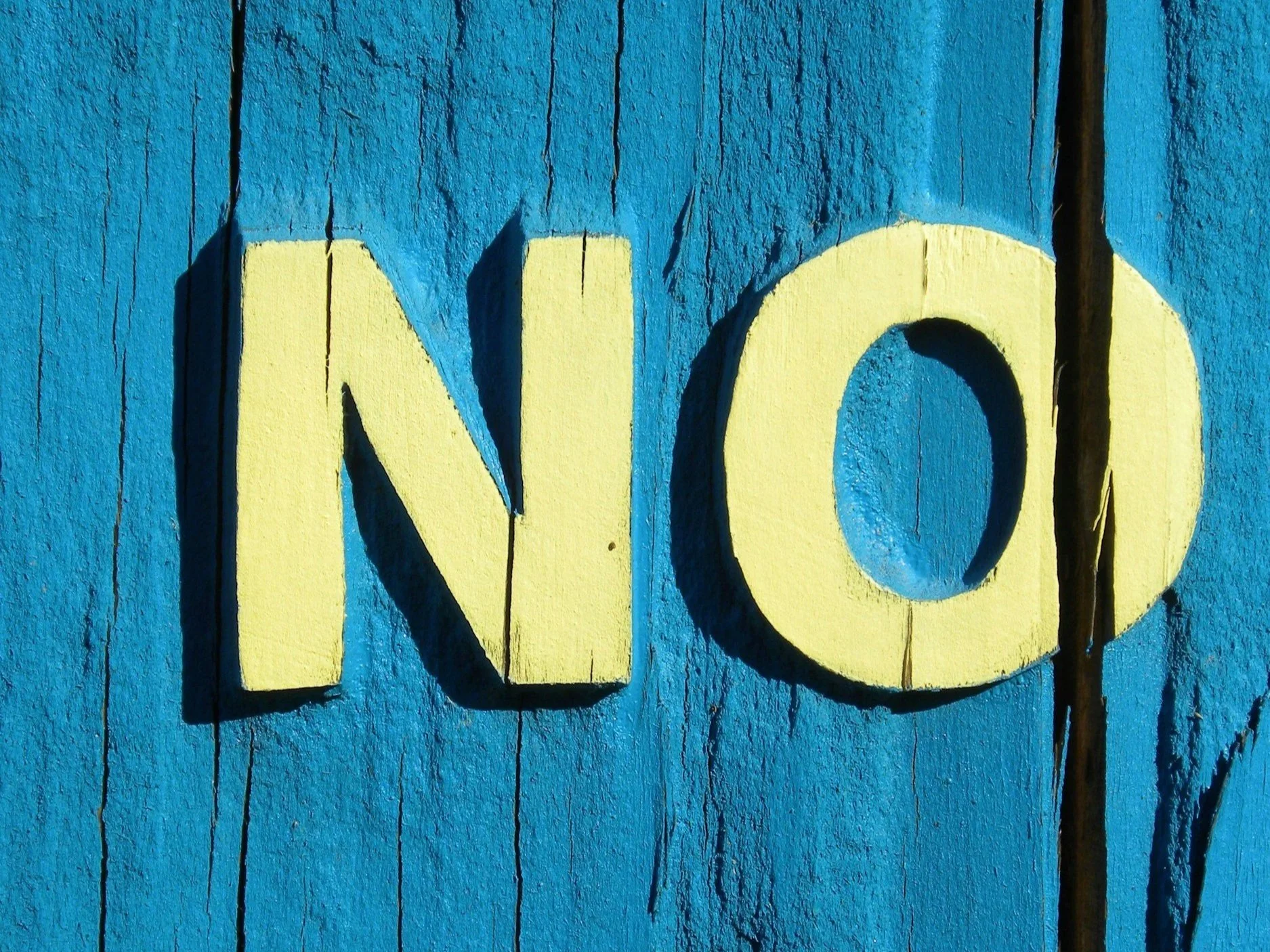
Image by @durken from Unsplash
NObody likes the word "no."
It lands like a small rejection, a closed door, a red light when you were moving perfectly well. We are conditioned from early on to want yes — yes to the request, yes to the idea, yes to the invitation.
Yes feels like welcome. No feels like removal.
But I have been thinking about all the "no"s in my life, and I am not sure they are what I once thought they were.
The ‘NO’ that comes from love
When we were young, our parents said no to second helpings of sweets. We sulked. We thought it was control. Looking back, it was care dressed in a firm voice. They said no to staying out late before exams. No to getting into cars with people they had never met. What felt like restriction was, in fact, a boundary drawn around us — not to cage us, but to keep us safe enough to grow.
And crucially, in my case: they helped me understand the reasoning. Not always in the moment — sometimes years later. But the no was never arbitrary. It came with a thread I could eventually trace.
I did not fully understand this until I was on the other side of it.
When my nephew and niece were young, I spent time caring for them. I was accountable to their parents, yes — but beyond that, I genuinely wanted them to grow up well. And so I said no too. No to the unhealthy treats they wanted. No to the thing that looked harmless but wasn't quite right. They were not pleased. I imagine I sounded exactly like my parents once did to me.
What I understood then, standing in my parents' shoes, was that the no was never about control. It was about caring enough to hold a line even when it made you unpopular. The child on the receiving end doesn't always see that. But the person giving it knows.
The ‘NO’ that costs you something
There is a kind of no that requires more courage — the one you say not to protect a child, but to protect your own integrity, often when no one would notice if you didn't bother.
In my tertiary days, attendance was taken on an honour system. A list was passed around the lecture hall, and students marked themselves present. Some took advantage of it. They would ask a friend sitting nearby to mark them down even when they had not shown up. It was small. It was common. It felt, to most people, like a harmless white lie — nobody was really being hurt, the friend would probably have come if they could, what does one absence matter?
Friends asked me to do it for them.
I said no. Every time.
Not loudly. Not with a lecture. I simply would not mark attendance for someone who was not there. It felt clear to me that it was wrong — not because I was going to be caught, but because I would know. Integrity, I have come to believe, is not about what you do when someone is watching. It is about what you do when no one is, and when everyone around you has quietly decided the small compromise is acceptable.
I did not lose friends over it. But I did gain a reputation — as the one who wouldn't do it. Not self-righteous about it. Just consistent. And eventually, people stopped asking.
There is something worth sitting with in that. You do not always have to pay a dramatic price for doing the right thing. Sometimes the cost is simply being known as someone who means what they say. That reputation, I have found, is not a burden. It is a foundation.
The ‘NO’ that looks like weakness
There is also the no we say in the face of pressure — peer pressure, social pressure, the pressure of wanting to belong. This one is underrated.
I remember being told, at some point in growing up, that when a bully comes for you, you do not have to prove anything. Sometimes the right answer is to say no, to walk away, and — crucially — to ask for help. Not because you are weak, but because walking away takes more self-possession than engaging. It means you have decided that what they think of you is not the measure of you.
Saying no to belonging — to the group, to the consensus, to the easy agreement — can feel like losing. From the outside, it can look like losing too. But there is a vote you cast every time you say no to something that isn't you, and that vote is for your own identity. It accumulates. Quietly, it shapes who you become.
The ‘NO’ that still hurts
I want to be honest here. Not every no resolves neatly.
Some "no"s you receive are just losses. Doors that closed and nothing better appeared behind them, at least not immediately, at least not in any way you could clearly connect. Some no's you gave cost you relationships that mattered, or left a silence where warmth used to be.
Gratitude for a no does not require pretending it wasn't a cost. It simply asks a different question: even if nothing better came of this, what did it protect? My integrity? My time? Someone else's wellbeing? My sense of who I am?
Sometimes the answer is modest. Sometimes it is unglamorous. But it is still worth asking.
A quiet reflection for Friday
So this week, if you are sitting with a no — one you received, one you gave, or one you are still turning over — perhaps let it sit a little differently.
Not every no is kind. Not every no makes sense in the moment. But some of them, quietly, were doing more for you than you knew.
And that is worth a moment of gratitude.
Think of a "no" you received that stung at the time. Looking back, what did it protect — even if nothing clearly better came from it?
Think of a "no" you gave, even when it was uncomfortable to give. What were you choosing, in that moment, to stand for?
Is there a no you are still sitting with — received or given — that you haven't quite made peace with? What would it take to hold it with a little more patience?
